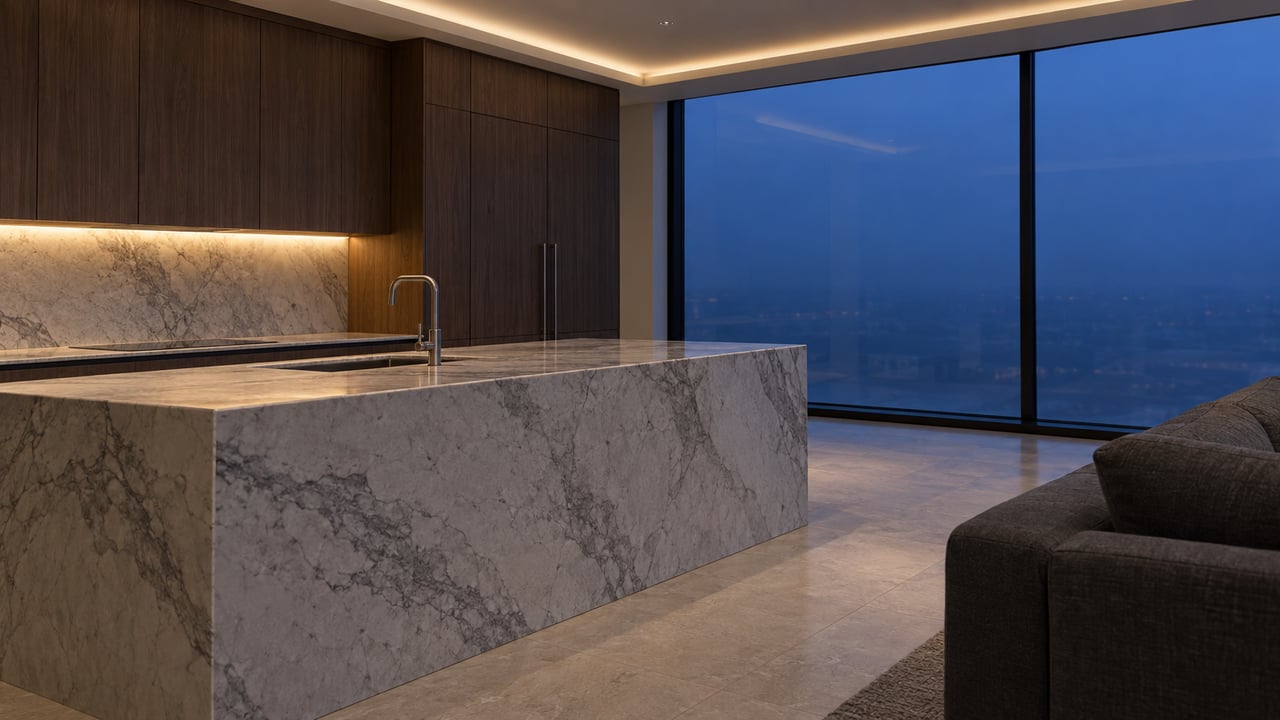
The conversation with a lender on a CityCenter condo tends to happen at roughly the same point in every transaction. The offer is accepted, the inspection is clean, and then the loan officer calls back with a question that has nothing to do with the unit itself: what does the building's rental policy actually allow, and how many of the other 224 owners are renting theirs out.
That question decides more about the deal than the square footage does.
At the Waldorf Astoria, the number most buyers fixate on first is the HOA statement. Recent closed-sale data pulled from the building's association records in late August 2026 puts the median due at roughly $3,276 a month, or about $39,312 a year before a mortgage payment is even factored in. Individual listings that month showed a range closer to $2,671 to $3,331 depending on floor and finish. A few blocks away, inside the same CityCenter footprint, Veer Towers carries a documented HOA range closer to $1,100 to $2,800 a month as of a buyer's guide published in May 2026, and the Waldorf trades at roughly a 25 to 40 percent premium per square foot over Veer on closed sales from that same period.
Read as a straight comparison, the Waldorf looks like the more expensive version of the same product. It isn't. It's a different product, and the fee is the evidence.
Two towers, one campus, two completely different bets
The Waldorf Astoria opened in 2009 as the Mandarin Oriental Las Vegas and took the Waldorf name in 2018. It was built from the start as private residential ownership stacked above a working hotel, with 225 individually deeded units beginning at the 23rd-floor sky lobby and a separate residential entrance and elevator bank below. There is no casino floor in the building, which is unusual for a Strip-adjacent tower and appears to be a deliberate part of the pitch: fewer transient guests moving through the lobby, a quieter arrival experience, and an ownership base that skews toward primary residents, pied-a-terre buyers, and long-term corporate tenants rather than nightly renters.
Veer Towers, a short walk away, started life differently. The two leaning glass towers were marketed for years as a condo-hotel play, and owners could opt into a rental program that put units into nightly and weekly inventory much like a hotel room.
Here is where the story gets more interesting than a simple before-and-after. A separate buyer's guide to Veer Towers published in May 2026 discloses an owner-occupancy ratio running around 35 to 45 percent. Building rental policy at Strip-corridor condo towers is not a fixed fact you can look up once and trust forever. It moves as HOA boards change, as management companies change, and as occupancy shifts. The honest answer for any buyer comparing these two towers in late 2026 is to request the current HOA documentation directly rather than rely on either building's reputation.
The ratio a lender checks isn't the one on the sales sheet
What actually determines whether a Strip-corridor condo qualifies for a conventional loan has less to do with whether Airbnb is technically allowed and more to do with a set of project-level tests that Fannie Mae and Freddie Mac apply to the entire building, not just the unit being purchased.
The core tests: at least 50 percent of units need to be owner-occupied or second homes for a lender to treat a purchase as an investment-property deal at standard terms; no single owner can hold more than roughly 20 percent of the units in a building of any real size; commercial space is capped near 35 percent of the project; and the HOA has to fund reserves at a minimum share of its annual budget. Fail any one of those tests and the entire building goes non-warrantable, which means every unit owner in it, not just the one selling, loses access to standard conventional financing and gets pushed toward portfolio loans, jumbo products, or cash, usually with 20 to 30 percent down and a rate a point or more above conventional.
A building with a 35 to 45 percent owner-occupancy ratio, like the disclosure describing Veer, sits close enough to that 50 percent line that its warrantable status can flip depending on how the next few closings shuffle the count. A building built from the ground up around long-term residents and corporate tenants, which is how the Waldorf's ownership base has been described, is structurally positioned further from that edge. The HOA fee isn't buying a nicer lobby at that point. It's buying, in part, the operating discipline that keeps the building financeable for the next buyer, which is also the next buyer for your unit when you decide to sell.
What changed for CityCenter towers in March 2026
On March 18, 2026, Fannie Mae and Freddie Mac issued coordinated updates that reshuffled which side of this line older Strip towers land on. Fannie Mae's Lender Letter LL-2026-03 and the matching Freddie Mac bulletin retired the old rule that automatically disqualified a project once investor ownership crossed 50 percent, at least for established projects reviewed under the agencies' Full Review path. That is a real loosening for towers like Veer that carry higher investor concentration.
It came paired with a tightening that cuts the other way. Reserve funding minimums moved from 10 percent of the HOA's annual budgeted income to 15 percent, and Limited Review, the simpler and faster underwriting path lenders used to use for smaller condo purchases, was eliminated entirely. Master insurance policies also face a new per-unit deductible cap of $50,000 for loan applications dated on or after July 1, 2026. For towers built in the 2007 to 2009 window, carrying original elevators, curtain walls, and pool decks now approaching two decades of age, that reserve threshold is the harder needle to thread, not the investor-concentration number that used to dominate the conversation.
The net effect for a CityCenter buyer weighing these two towers in late 2026: the rental-policy question hasn't disappeared, but it now shares the stage with a reserve-funding question that a rental ban alone doesn't answer. Ask for the building's most recent reserve study and its percent-funded figure before assuming the HOA fee reflects a healthy account.
What Nevada law hands you before you're locked in
Nevada treats condominium associations as common-interest communities under NRS Chapter 116, and that statute does most of the work of getting a buyer the numbers described above before closing. When a resale unit changes hands, the seller is required to provide a resale package under NRS 116.4109 that includes the association's current budget, its reserve summary, any unpaid assessments tied to the unit, and disclosure of pending legal action against the HOA. Buyers get a five-day right to cancel after receiving that package, which is enough time to have a lender or an attorney read the reserve figures rather than take the listing agent's word for them.
Nevada also requires associations, under NRS 116.31152, to commission a full reserve study at least every five years and review it annually, covering the remaining life and replacement cost of major building components. That means a real percent-funded number exists for both the Waldorf and Veer, not a guess. A building sitting above 60 percent funded is generally considered in reasonable shape. One well below that is telegraphing either a dues increase or a special assessment, and possibly a warrantability problem if the annual reserve contribution falls under the required threshold.
Reading the two towers side by side
The Waldorf's higher HOA fee reflects a fee-simple residential building with no rental-pool program, a hotel amenity package layered on top through a Hilton services agreement, and an ownership base weighted toward primary residents and long-term tenants rather than short-stay guests. Veer's lower fee reflects a building built for flexibility, later pulled partway back from that model by its own owners, still carrying a rental-management program and an occupancy ratio close enough to the agency threshold that its financing terms are worth confirming building by building rather than assuming from the address.
Neither structure is the wrong choice. They're priced for different buyers, and the HOA statement is the clearest early signal of which buyer a given tower was built for.
A few questions worth asking before you write an offer
Does a lower HOA fee mean a healthier reserve account? Not necessarily. A lower fee can mean a leaner amenity package, or it can mean the association is under-reserving for the 15 percent minimum now required. The percent-funded figure in the reserve study answers this, not the monthly due.
Can a buyer still get a conventional loan at a CityCenter tower with a higher investor concentration? It depends on where the building's owner-occupancy ratio sits relative to the 50 percent test and whether it is being reviewed under the agencies' Full Review path following the March 2026 rule change. This is confirmed loan by loan, not building by building, so the same tower can qualify for one buyer's financing and not another's depending on timing.
If you are weighing a CityCenter address against another Strip-corridor tower and want the current HOA disclosures and financing picture explained in plain terms, MS Luxury Homes can walk through what a specific building's numbers mean for your offer before you write one.
This article is general information, not legal, tax or financial advice. Consult a qualified professional about your situation.